

Software Sustainability: An Investment That Protects Your Business Future
Technology Does Not Age... But Bad Decisions Do How Do Outdated Technology Decisions Become a Hidden Cost That Hinders Business Growth?
The Problem Is Not That Technology Is Old
There is a common belief in the business world
If a system becomes old, it should be replaced.
But reality is more complicated.
A ten-year-old system may still operate efficiently, while a modern system purchased just one year ago may fail to deliver any real value.
A company may have the latest AI tools, the best cloud services, and a large number of applications, yet still struggle with slow processes, duplicate data, poor coordination, and difficulty making decisions.
So, where is the problem?
In many cases, the problem is not the age of the technology.
The problem lies in the decision that introduced it into the organization, how it is operated, and how well it aligns with current processes and objectives.
This leads to the central idea of this article:
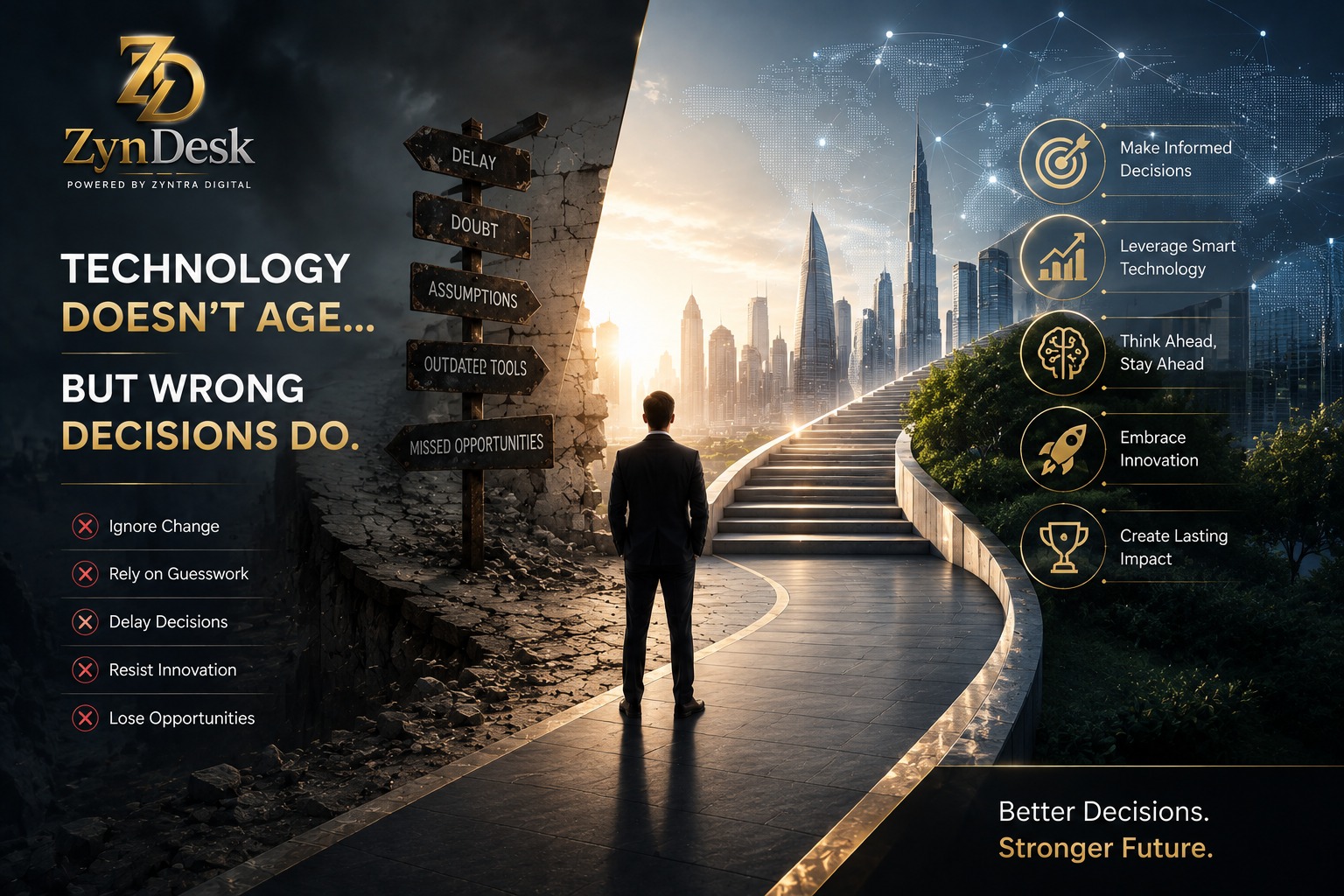
Technology does not age as quickly as bad decisions do.
A system that was appropriate five years ago may become unsuitable today—not because it is "old," but because the company itself has changed.
The number of customers has changed.
The volume of data has changed.
The way the business operates has changed.
Customer expectations have changed.
Cybersecurity has changed.
And AI has reshaped business processes.
So the question is no longer:
Do we need newer technology?
It is:
Does the technology we use today still support the way we want the company to operate tomorrow?
Executive Summary
A good technology decision does not begin with the question:
What is the latest technology on the market?
It begins with five questions:
· What problem are we trying to solve?
· What business outcome do we want to achieve?
· Is the problem with the technology or with the process?
· Can the current system evolve with us?
· What is the cost of not changing compared with the cost of changing?
If a company cannot answer these questions, purchasing new technology may create new complexity instead of solving the old problem.
Why Do Some Companies Fail Despite Having the Latest Technology?
Having technology does not necessarily mean being able to use it effectively.
A company may have:
· Cloud
· AI Tools
· Dashboards
· Automation
And yet its teams may still operate in isolated silos.
Sales has one set of data.
Finance has another.
Customer service has a different record.
Operations depend on Excel files.
And management waits until the end of the month for reports.
At this point, the problem is not a lack of technology.
It is the lack of integration between technologies.
Value does not come solely from purchasing tools. It comes from how technology is integrated into the operating model.
1. The First Wrong Decision: Buying Technology Before Defining the Problem
One of the most common mistakes is for an organization to start with the product.
"We need a CRM."
"We need AI."
"We need an ERP."
"We need Automation."
But the better question is:
Why?
If the sales team is not following up with customers because the process is unclear, purchasing an advanced CRM will not solve the problem on its own.
If employees repeatedly enter the same data, the problem may be system integration.
If a manager does not know why a process is delayed, the problem may lie in the Workflow design rather than the Dashboard.
If the data is unstructured, adding AI on top of it may not produce reliable intelligence.
The Better Decision
Start with:
Problem → Process → Data → Technology → Measurement
Not:
Technology → Trying to Find a Problem for It
2. The Second Decision: Choosing a System Because It Is "Modern"
The word "modern" does not necessarily mean "suitable."
A system may be highly advanced from a technical perspective, yet fail to fit:
· Company size
· Team structure
· Processes
· Budget
· Regulatory requirements
· Existing integrations
· Digital maturity level
Technology should therefore be evaluated according to its strategic fit, not its age or popularity.
Question
The Right Decision
Does it solve a real problem?
Validate before purchase
Does it integrate with existing systems?
Verify before implementation
Can it scale with the business?
Evaluate future growth
Can the team use it effectively?
Test adoption
Can its value be measured?
Define KPIs
Does it protect data?
Assess security and governance
Can it be changed later?
Assess flexibility and exit costs
3. The Third Decision: Ignoring Technical Debt
Technical debt does not always appear on the balance sheet.
It may appear as:
· Additional working hours
· Manual processes
· Repeated errors
· Fragile integrations
· Difficulty training employees
· Slow reporting
· Dependence on a single employee
· Difficulty updating the system
· Increasing support costs
The problem is that these costs are distributed across different departments.
Therefore, a manager may not see them as one cost.
But collectively, they become a real cost.
Example
A company uses three separate systems:
System A: Customers
System B: Operations
System C: Finance
Employees manually transfer information between them.
Each transfer may take only a few minutes.
But when repeated thousands of times, those minutes become a significant operational cost.
The question is therefore not:
How much does the new system cost?
It is:
How much does the current system cost us every day?
4. Technology Does Not Become Outdated Simply Because Its Version Changes
There is a difference between:
Technology Aging
The technology itself becoming outdated.
And:
Decision Aging
The decisions governing how that technology is used becoming unsuitable.
The technology may still be supported.
But:
· Processes have changed.
· The market has changed.
· Customers have changed.
· Data volume has doubled.
· Security requirements have increased.
· The team has grown.
· The company has expanded to multiple branches.
In this situation, the problem may lie in the operating model rather than the system itself.
5. Do Not Replace the System Before Understanding Why It Is Failing
When a company faces a problem with its system, there are four possible scenarios:
Cause
Potential Solution
The system is unsuitable
Replace or select a different system
The system is suitable but poorly configured
Redesign the configuration
The process itself is wrong
Re-engineer the process
The team is not properly trained
Adoption & Training
This is where diagnosis becomes important.
Not every bad system needs to be replaced.
Sometimes, purchasing a new system is the easiest management decision—but it is not necessarily the best one.
6. AI Has Made the Problem More Visible
AI has led companies to ask:
What can AI do for us?
But the more important question is:
Is the organization actually ready to use AI?
If the data is:
· Distributed
· Inaccurate
· Outdated
· Without clear permissions
· Without context
· Unstructured
Then adding AI may simply add speed to an unstructured system.
AI should therefore be treated as part of the organization's strategy, risk management, and data management—not merely as another new tool to activate.
7. The Problem Is Not AI vs. Humans
The real question in the coming years will not be:
Will we replace humans with AI?
It will be:
How do we redistribute work between humans and machines?
Technology can handle:
· Repetitive tasks
· Data classification
· Summarization
· Pattern detection
· Alert generation
· Some data-entry activities
· Initial report preparation
While humans retain decisions that require:
· Professional judgment
· Accountability
· Contextual understanding
· Handling exceptional cases
· Strategic decision-making
The goal is not to make the company more automated.
The goal is to make it smarter and less dependent on unnecessary manual work.
8. The Biggest Mistake: Adding Tools on Top of Tools
Every new tool may appear useful.
But over time, a company may find itself with:
10 tools × 10 processes × 10 = Increasing integration complexity
The problem is not simply the number of tools.
The real question is:
Do you know where the truth is?
If the customer exists in four systems, the task is in a fifth, the invoice is in a sixth, the document is in Drive, and the approval is in WhatsApp, the company does not have a unified operating system.
It has a collection of digital islands.
9. From Too Many Tools to an Operating System
More mature companies do not think only about tools.
They think about:
How does information move through the company?
For example:
Customer → Contract → Service → Workflow → Task → Document → Review → Delivery → Billing → Collection
This chain is more powerful than simply owning ten separate software applications.
Because it connects:
Data + People + Processes + Technology + Decisions
At this point, technology becomes an operating layer rather than a collection of applications.
10. The Smart Decision: Choose Flexibility, Not Fashion
When evaluating any technology, do not ask only:
What can it do today?
Also ask:
What could it do two years from now?
Ask:
· Does it integrate with my systems?
· Can data be migrated from it?
· Can additional users be added?
· Can the Workflow be changed?
· Does it support automation?
· How are permissions managed?
· How are events logged?
· How is data handled?
· What does scaling cost?
· What does exiting the platform cost?
Good technology is not the technology that wins a presentation.
Good technology is technology that does not trap you three years later.
11. When Do You Know That an Old Technology Decision Has Become a Burden?
Watch for these signs:
1. Employees Depend on Excel Outside the System
This may indicate that the system does not fully support the process.
2. The Same Data Is Entered More Than Once
This is a sign of weak integration.
3. A Manager Needs More Than One Source to Know the Truth
This indicates fragmented data.
4. Reports Require Manual Preparation
There may be an opportunity for automation.
5. A New Employee Needs a Long Time to Understand the System
Operational knowledge may be trapped in individuals.
6. The System Works, but the Team Hates Using It
This is an Adoption problem that cannot be ignored.
7. Any Change Requires Significant Technical Intervention
This may indicate poor flexibility.
8. The Company Is Growing Faster Than the System
This is one of the most dangerous warning signs.
12. Do Not Ask Whether the System Is Old
Instead, ask five questions:
Question
Why Does It Matter?
Does it serve the company's objectives?
Alignment
Does it support current processes?
Operational Fit
Can it scale?
Scalability
Does it protect data?
Security
Can its value be measured?
Business Impact
If the answers are positive, age may not be the problem.
But if most answers are negative, the organization may need to rethink its technology—even if the system is "modern."
13. How Do You Make a Better Technology Decision?
Use the following model:
Stage One: Diagnose
Identify:
· The problem
· Its cause
· Its impact
· The number of people affected
· The current cost
Stage Two: Define
Define:
· The desired outcome
· KPIs
· Requirements
· Constraints
Stage Three: Compare
Compare solutions based on:
· Cost
· Integration
· Security
· Flexibility
· Ease of use
· Scalability
· Data
· Support
Stage Four: Pilot
Do not always start by transforming the entire organization.
Test the solution within a limited scope.
Stage Five: Measure
Compare:
Before vs. After
Do not rely on impressions alone.
Stage Six: Scale
If the solution proves its value:
Expand its use gradually.
14. Technology That Is Not Measured Becomes a Cost
One of the most important questions after implementing any system is:
What changed?
It is not enough to say:
"We have a new system."
You must be able to measure:
· Process completion time
· Number of errors
· Manual working hours
· Response time
· System adoption rate
· Process cost
· Customer satisfaction
· Reporting speed
· Number of automated processes
The goal of technology is not to own technology.
The goal is to change the outcome.
15. The Right Technology Decision Is Not Always the Cheapest
Sometimes the cheapest solution becomes the most expensive one over the long term.
Why?
Because it may require:
· Additional tools
· Integrations
· Ongoing support
· Custom development
· Manual intervention
· Additional training
· Future rebuilding
Therefore, organizations should calculate:
Total Cost of Ownership — TCO
Not simply the subscription price.
16. Do Not Forget the Cost of Inaction
There is another type of cost that does not appear in pricing proposals:
Cost of Inaction
What happens if you do not change anything?
The result may be:
· Continued delays
· Lost opportunities
· Increased operating costs
· Poor customer experience
· Increased risks
· Loss of knowledge
· Difficulty scaling
Sometimes, not making a decision is itself a decision.
17. Technology Decisions Require Governance
The more impact technology has on the business, the more important governance becomes.
The organization must know:
· Who owns the decision?
· Who approves it?
· Who owns the data?
· Who can access it?
· Which tools are permitted?
· How are risks evaluated?
· How are systems reviewed?
· What happens when a system fails?
· How is change managed?
For AI in particular, the organization needs a clear framework for managing risks, data, permissions, and responsible use.
18. Modern Technology Requires Modern Decisions
Real change is not:
Legacy → New
It is:
Old Thinking → Better Decisions
A company may use the latest Cloud Platform with an outdated mindset.
Another company may use an older system while having clear processes, organized data, and continuous measurement.
Therefore, modernization should not begin with devices and software.
Start with the way you think.
19. Five Decisions That Make Technology a Strategic Asset
Decision One: Connect Technology to the Business Objective
Every technology project should have a clear business reason.
Decision Two: Design the Process Before Automation
Do not automate chaos.
Decision Three: Make Data a Central Asset
Fragmented data reduces the value of technology.
Decision Four: Design for Change
Do not build a system that assumes the company will never change.
Decision Five: Measure Results Continuously
Technology is not a project that ends at go-live.
20. What Should a Manager Do Today?
Before purchasing any new system, bring the management team together and ask:
What are the five processes that consume the most of our time?
Then:
What are the five processes that cause the most errors?
Then:
Where do we enter the same data more than once?
Then:
Where do we need to ask an employee to know the status of work?
Then:
What decision are we unable to make because the data is unavailable?
These five answers may reveal your real technology needs more clearly than dozens of product presentations.
Technology Does Not Age. Decisions Do.
Ultimately, technology is not merely software and hardware.
It is a reflection of the decisions an organization makes.
The decision to purchase a system.
The decision not to integrate.
The decision to delay modernization.
The decision to ignore data.
The decision to use AI without governance.
The decision to add another tool instead of fixing the process.
The decision to measure activity instead of outcomes.
Each of these decisions may seem logical at the time.
But the problem begins when the organization continues applying the decision after circumstances have changed.
That is when an old decision becomes strategic debt.
Organizations that succeed in the coming years will not necessarily be those using the largest number of technologies.
They will be the organizations that know:
When to use technology, why to use it, how to measure its value, and when to change their decision.
That is the difference between an organization that buys technology and one that builds digital capability.
Recommended Articles from ZynDesk
If you want to explore technology strategy and digital transformation further, you can read:
1. The Future of Business Platforms: From Separate Systems to a Unified Fabric
ة2. User Experience in Enterprise Systems
3. Cybersecurity in Modern Business Platforms
4. AI and the Future of Business Management
5. Why Was ZynDesk Created?
How Can ZynDesk Support This Approach?
In a modern business environment, managing customers, tasks, or data individually is not enough.
Value emerges when information moves through a clear workflow.
A modern operating model can be viewed as:
Client → Service → Workflow → Task → Document → Review → Delivery → Billing → Collection → Dashboard
The idea is not to add another tool to an already crowded technology stack.
The idea is to build an operating environment that helps management see the relationship between different elements of the business instead of treating them as separate islands.
This is what makes integrated operating platforms increasingly important as companies grow and their processes become more complex.
Checklist: Are Your Technology Decisions Still Appropriate?
Ask yourself:
· Do we know why we use each system?
· Do we have duplicate systems performing the same function?
· Do we enter data more than once?
· Are our systems connected?
· Do we know the cost of manual processes?
· Can we generate reports quickly?
· Do we know who owns each technology decision?
· Do we have a policy for using AI?
· Do we regularly review access permissions?
· Do we measure the results of technology investments?
· Are our systems scalable?
· Can we migrate our data if we change vendors?
· Does the system support the way we currently work?
· Do we regularly review our technology decisions?
If the answer is no to many of these questions, you may not need to buy more technology.
You may first need to rethink the technology you already have.
Frequently Asked Questions (FAQ)
Is old technology always bad?
No. The age of technology alone does not determine its value. An older system may remain suitable if it is secure, reliable, maintainable, and aligned with the organization's needs.
When should an old system be replaced?
When the system becomes a clear obstacle to the company's objectives, or can no longer keep pace with security, integration, scalability, or current operational requirements—and a viable alternative exists.
What is Technical Debt?
Technical debt is the accumulation of technology decisions or shortcuts that make maintaining and developing systems more costly or complex in the future.
Does buying a newer system solve a company's problems?
Not necessarily. If the problem lies in processes, data, training, or management, the same issue may simply be transferred to the new system.
Should every company use AI?
Not necessarily, and not in the same way. The best approach is to identify clear use cases, connect them to measurable value, and establish appropriate controls for data and risks.
How do I know whether a technology investment is successful?
Through clear indicators such as reduced process time, fewer errors, less manual work, faster decision-making, improved service quality, or a measurable business outcome.
What is the biggest mistake in digital transformation?
Treating digital transformation as the purchase of software instead of viewing it as a change in processes, data, ways of working, and decision-making.
What is the difference between digital modernization and digital transformation?
Modernization may involve improving or replacing an existing system, while digital transformation is broader and involves redesigning how the organization operates and using technology to achieve new or better outcomes.
Conclusion
Technology does not age, but bad decisions do.
The system you chose years ago was not necessarily a bad decision.
But continuing to use it without reviewing it may eventually become a bad decision.
And the solution is not always to buy the newest technology.
Sometimes, the solution is:
Understand the problem.
Then:
Redesign the process.
Then:
Organize the data.
Then:
Choose the right technology.
Then:
Measure the outcome.
In a world where AI, cloud infrastructure, and automation are evolving at an accelerating pace, the ability to reassess technology decisions themselves has become a strategic advantage.
Technology evolves.
The market changes.
Companies grow.
And a decision that was right yesterday is not guaranteed to be right tomorrow.
So do not ask only:
What technology do we need?
Ask:
What decision does our company need to make now?
Is It Time to Rethink How You Operate Your Business?
If customer data, processes, tasks, documents, and follow-up activities are distributed across multiple tools, the first step may not be adding another tool.
It may be building a clearer view of how work moves through your organization.
Discover how ZynDesk can help you build a more organized, connected, measurable, and scalable operating environment.